
How to Experience a Budget Safari in Tanzania
Updated: Jul 15
Hustling in Arusha for a Cheap Safari
Arusha, a bustling town in northern Tanzania, is the gateway to the country’s legendary safaris. I arrived with dusty boots and high hopes of arranging a safari without breaking the bank. The moment I stepped off the bus, I was swarmed by local touts offering safari packages. Everyone promised the “best price, best tour,” but as a solo backpacker, I knew I had to haggle hard.
Initial quotes for a 3-day Serengeti & Ngorongoro camping safari started around $2000 – an astronomical sum that nearly made me choke on my chai. Luckily, I’d done my homework and knew these prices were heavily inflated for tourists. With patience and a few Swahili greetings, I joined forces with a couple of other travelers to bargain as a group.
After two days of back-and-forth (and politely declining a dozen overpriced offers), we finally scraped together a reasonably-priced safari with a small local operator. We paid less than half the first quote – about $800 each for three days, all inclusive. It was still a splurge for my budget, but far more palatable than the initial ask, proving that persistent haggling can save you a small fortune in Tanzania.
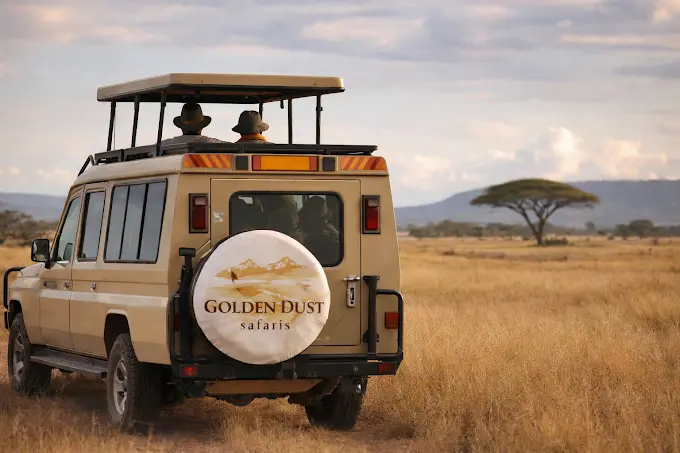
Our shoestring deal included joining a mixed group safari to split costs. That meant cramming into an aging Toyota Land Cruiser with a pop-up roof, along with five other adventurers and our Tanzanian guide/driver. We opted for camping instead of lodges – the cheapest way to safari. This meant pitching tents in public campsites out on the savannah. No glamping luxury here; just a thin canvas between us and the wild. Exactly what I wanted.
Our trusty safari 4x4 parked against the misty Ngorongoro Crater backdrop. Budget group tours use these hardy vehicles to tackle Tanzania’s rugged roads. This one had seen better days, but it got us through mud, dust, and river crossings just fine.
Safari on a Shoestring: Camping in the Wild
I’ll admit, as our 4x4 clattered through the entry gate of Serengeti National Park at dawn, I had butterflies in my stomach. The savannah unfolded to the horizon, an endless expanse of gold dotted with flat-topped acacia trees. Almost immediately, we spotted wildlife: a herd of zebra skittering by the roadside and giraffes nibbling the treetops.
Our guide, Joseph, had an eagle eye and a crackling radio to communicate with other drivers about sightings. Despite being a “budget safari Tanzania style,” we were privy to the same incredible wildlife as any high-end tour. Each day was a whirlwind of pinch-me moments. We woke before sunrise to make the most of morning game drives. In the soft light of dawn, the grasslands glowed and the air was crisp.
We watched a lioness and her cubs pad quietly through the mist, and later a parade of elephants crossed so close to our jeep I could almost touch their rough grey hide. We ate simple packed lunches under a lone acacia (with one eye on the cheeky vervet monkeys lurking, hoping to snatch a bite). By afternoon, we bounced over rutted tracks to catch a distant cheetah lounging on a termite mound.
The fact that I was experiencing all this on a shoestring budget made it even sweeter – I wasn’t ensconced in a fancy lodge, but rather feeling the wind in my face and dust in my hair as we chased adventure.
Nightfall brought a whole new thrill. At our campsite in the Serengeti, there were no fences – just a designated area where we pitched our tents in the middle of the wild. As we cooked a simple dinner over a campfire, hyenas whooped in the distance. I won’t lie: stepping away from the fire to use the toilet tent in the dark made my heart pound. My headlamp caught the shiny eyes of something (probably an impala) in the bush, and I scurried back to the circle of light pretty fast.
One night, a deep grunting outside our tent woke me – a buffalo was grazing just a few feet away. I held my breath, exhilarated and a little scared, until it lumbered off into the darkness. Moments like these – lying in a flimsy tent, hearing lions roar in the distance – made me appreciate that a budget safari can feel far more immersive than a cushy lodge stay.
We had no fancy buffet or hot shower (just a wet wipe wipe-down and a cold beer from the ranger station), but falling asleep under a sky bristling with stars, with the sounds of Africa all around, was priceless.
Local Insights and Off-Beat Encounters
Traveling on a budget often means trading comfort for authenticity. In our little safari group, we had a Tanzanian cook who rode along and kept us fed with hearty, no-frills meals. Over plates of ugali (maize porridge) and stew, I peppered him with questions about local life and learned a few Swahili phrases.
I found out that “simba” means lion (yes, like The Lion King), and that Tanzanians have a sly nickname for the ubiquitous safari vehicle: “daladala with a pop-top” – a joke comparing safari jeeps to the crowded minibuses locals use. Those little conversations by the campfire, with hyena calls in the background, gave me a deeper connection to the place.
On the road between parks, our guide pulled over at a Maasai village (boma) for a short cultural visit. A group of Maasai warriors in bright red shúkà cloth welcomed us with their iconic jumping dance. We got a glimpse of their nomadic lifestyle – peeking into a smoke-filled mud hut and watching the women perform a traditional song.
It was fascinating, yet I had mixed feelings. The visit felt a bit staged for tourists, complete with an obligatory craft market at the end. I’d read that many village tours are set up mainly as tourist traps, with staged rituals and aggressive souvenir sales. Our guide assured us the fee was shared with the community, and perhaps it was, but I still wondered whether we were intruding or helping.
This is one of the contradictions of traveling in Tanzania: you crave genuine cultural experiences, but you have to be mindful of whether they’re respectful and beneficial to locals, or just “human safaris” put on for show. Next time, I’d seek out a community-run tour or a homestay to ensure my visit supports the people authentically.
Beyond the famous parks, I discovered some off-the-beaten-path gems ideal for backpackers. One was Arusha National Park, often skipped by those rushing off to Serengeti. It’s smaller and has no lions, but it offers something unique: the chance to do a walking safari with a ranger and see animals like giraffes and buffalo on foot.
It’s also far cheaper than Serengeti in fees and can even be done as a day trip from town. After my big safari, a new friend from the hostel and I hopped on a daladala (local minibus) to Arusha National Park for a day. For a few dollars in transport and a modest entry ticket, we got to paddle a canoe on Momella Lake watching flamingos and hike through misty forests at the base of Mount Meru, coming face-to-face with curious black-and-white colobus monkeys.
It was the perfect low-cost adventure to round out my safari experience – proving you don’t need to spend big to enjoy Tanzania’s nature.
The Hard Truths of Budget Travel in Tanzania
I won’t romanticize it too much – traveling Tanzania as a backpacker has its challenges. For one, safaris are expensive, no matter how you do them. Park fees alone can burn a hole in your budget. In Serengeti, for example, the entry fee was around $80 per person per day, plus about $30 for camping per night – and that’s before paying for the guide, vehicle, and food.
These fees are set by the government and non-negotiable, so even if you’re wondering how to travel Tanzania on a budget, some experiences will have unavoidable costs. I learned to save in other areas (like sleeping in hostel dorms and eating street food) in order to afford these big-ticket adventures.
Another reality: as a foreigner, you’ll often be quoted higher prices for everything. Bargaining isn’t just a nice skill here – it’s essential. I had to negotiate for souvenirs, taxi rides, even bottles of water in the market. It can get exhausting to argue over prices all day, but it’s part of the journey.
One time in Arusha, a shopkeeper cheerfully tried to charge me five times the going rate for a hand-painted postcard. I just laughed and counter-offered about 80% lower; we eventually struck a deal closer to local price. When arranging safaris or tours, the markup can be even more extreme. I heard tales of quotes dropping from $1500 to $600 after fierce haggling (my own experience was similar).
The strategy seems to be: start ridiculously high and see what you can get. It’s rough when they apply that same strategy to budget backpackers, but with a mix of humor, patience, and walking away when needed, I never paid more than I should have.
Overtourism is also something I grappled with in the popular parks. In Ngorongoro Crater, for example, I was stunned by the traffic jam of safari jeeps that formed around a poor rhino trying to cross the road. There must have been two dozen vehicles vying for a view – it felt like a wildlife paparazzi scrum. Our guide, used to this, mentioned that peak season is even crazier with twice as many trucks.
In those moments, I felt a twinge of guilt, knowing I was part of the crowding problem. It can detract from the wilderness vibe when dozens of safari vehicles surround an animal. Fortunately, I traveled in the shoulder season (early June), so we had relatively quieter parks and even some campsites to ourselves.
If you have flexibility, I highly recommend timing your trip for just before or after high season – not only to save a bit on costs, but to ensure a more intimate experience. In peak months, prices skyrocket and even park entrance fees can double, all while popular spots get swarmed.
Despite these challenges – or maybe because of them – I found backpacking in Tanzania immensely rewarding. The hardships and the wonders go hand in hand. One day you’re squeezed in a sweaty bus with a chicken on your lap, the next you’re standing on the edge of the world’s largest caldera watching elephants stroll below. It’s the contrast that makes it an adventure.
Final Thoughts: Savvy, Not Cheap
In the end, my Tanzanian safari taught me that “budget” travel doesn’t mean skimping on experience – it means being resourceful, savvy, and open to trade-offs. I still spent a chunk of cash for my safari, but every dollar felt well spent when I think back on the roar of lions at night or the awe of seeing a wild elephant up close for the first time.
I also came to cherish the parts of travel money can’t buy: the camaraderie of fellow travelers as we passed around a shared bottle of Kilimanjaro beer in camp, or the kindness of a local family who invited me, a stranger, to shelter from the rain under their shop awning in Arusha.
If you’re dreaming of a safari in Tanzania but your wallet is thin, don’t write it off. With determination and the right approach, a budget safari Tanzania experience is absolutely possible. Choosing a reliable local operator like Golden Dust Safaris can also help you enjoy a well-organized adventure while making the most of your budget.
You might find that camping under the stars beats a luxury lodge any day, and the stories you bring home are all the richer for having earned them the hard way. Tanzania’s wild places will reward you with memories for a lifetime… and you’ll have the pride of knowing you did it your way, on a backpacker’s budget.


Comments